Smartphones & Accessories / Review
Google Pixel 9 Review: A balanced Pixel for everyday photographs
Pixel 9 combines a useful two-camera system with a long published support window, without the Pro’s telephoto.
Review basis: This is a research-based editorial review of manufacturer documentation and published product specifications, not a hands-on test. Ratings reflect documented features and buying tradeoffs; performance claims are attributed to their sources.
A clear place in the range
The Pixel 9 suits someone who wants Google's phone experience in a conventional, moderately sized device and does not need a dedicated telephoto camera. Its 6.3-inch display, Tensor G4 processor and 12GB of memory make it a broad everyday proposition. The important choice is between the standard model's practical coverage and the Pro's more specialized hardware. For a buyer whose photographs mostly involve people nearby, rooms, documents and landscapes, the standard configuration can be sufficient without paying for capabilities that rarely enter the routine.
Wide and ultrawide coverage
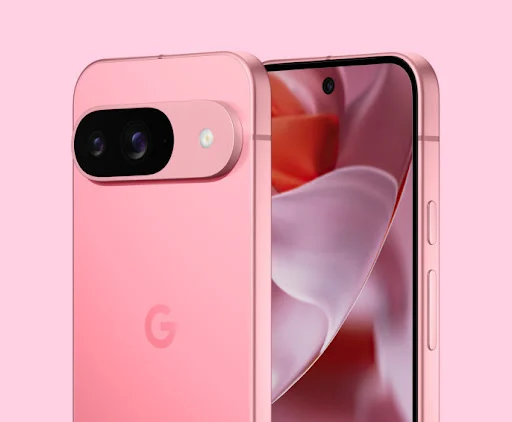
Google specifies a 50-megapixel main camera and a 48-megapixel ultrawide with Macro Focus. Those cameras cover ordinary scenes, wider compositions and close details. The limitation appears when a subject is distant: digital zoom is available, but the phone has no separate long telephoto lens. That distinction matters for concerts, wildlife and field sports. It matters less for a household camera used at normal conversational distances. Before choosing between models, look through your existing photo library and identify whether distant subjects are actually common enough to justify different hardware.
Screen and daily interaction
The Actua OLED display operates across a 60–120Hz range. That gives the Pixel 9 a useful smooth-scrolling specification, although it is a different panel proposition from the Pro's more broadly variable LTPO design. The phone includes Google's software and AI features, but availability can depend on language, account, region and service conditions. Treat those functions as tools to evaluate individually. A phone should remain a good purchase based on its display, controls, camera and communications even if a particular cloud feature changes or proves less useful than its demonstration suggested.
Support is measured from launch
Google promises seven years of operating-system and security updates from first availability in the US Google Store. That is a meaningful ownership advantage, particularly for people who retain phones for several years, but the clock does not restart when an older unit is purchased. Check the remaining support period when comparing discounted stock. The 4,700mAh typical battery capacity is another useful specification rather than an individual runtime guarantee. Charging accessories, network conditions and daily workload all affect the experience, so avoid treating a charger's advertised wattage as the phone's continuous charging speed.
Verdict
The Pixel 9 is a good match for a buyer who values a coherent Google experience, nearby-subject photography and a clearly stated support policy. The Pro becomes more persuasive when telephoto framing or its display characteristics solve a specific need. Heavy storage users should select capacity deliberately because expansion is not part of the design. For everyone else, the strongest purchase case is the combination of everyday camera coverage and remaining support. Compare the actual selling price and condition against newer alternatives, while keeping those practical priorities ahead of a feature count.
Sources
What works well
- Main and macro-capable ultrawide cameras
- 60–120Hz OLED display
- Seven-year published update policy from first availability
What to consider
- No separate telephoto camera
- Support period starts at release
- Cloud features can vary by market and service
At a glance
- Display
- 6.3-inch Actua OLED, 60–120Hz
- Processor
- Google Tensor G4
- Memory
- 12GB
- Battery
- 4,700mAh typical
- Rear cameras
- 50MP wide; 48MP ultrawide