Music & Instruments / Review
BOSS TU-3 Review: A floor tuner built around a visible everyday task
The BOSS TU-3 is a sensible purchase for a guitarist or bassist who wants tuning integrated into an amplified setup. Its foot-operated format places a clear, dedicated display on the pedalboard and makes checking pitch…
Review basis: This is a research-based editorial review of manufacturer documentation and published product specifications, not a hands-on test. Ratings reflect documented features and buying tradeoffs; performance claims are attributed to their sources.
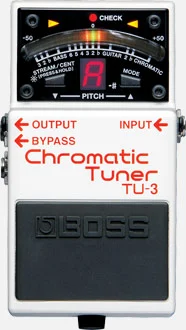
The BOSS TU-3 is a sensible purchase for a guitarist or bassist who wants tuning integrated into an amplified setup. Its foot-operated format places a clear, dedicated display on the pedalboard and makes checking pitch part of the normal performance routine. The benefit is less about adding a new musical effect than removing friction from a task that happens repeatedly.
BOSS specifies a 21-segment LED display, a high-brightness mode and tuning accuracy of plus or minus one cent. These are useful features for reading pitch on a floor-based unit. The accuracy figure describes the tuner, however, rather than guaranteeing that an instrument will remain perfectly in tune across every fret. String condition, setup, technique and temperature remain part of the result.
Why a pedal tuner can be worth the space
A pedal format is useful when an instrument is already connected by cable and the player wants to check tuning without handling another device. A consistent position on the board is easy to find, and the display can be read while standing. For a musician moving between songs, that repeatability may be more valuable than a large collection of extra functions.
The TU-3 offers chromatic operation alongside guitar and bass modes. Chromatic tuning is particularly useful when the desired note names do not follow a conventional preset tuning. Instrument-oriented modes can make familiar routines easier to read. Buyers should still understand which mode is active so that the display is interpreted correctly rather than simply followed until a light appears centered.
Its output arrangement allows tuning to be integrated with an amplified signal path. Before a rehearsal or performance, confirm how the chosen output behaves when the pedal is engaged. A muted tuning path and an always-audible path serve different purposes. Planning that routing is preferable to discovering it while an audience can hear every adjustment.
A straightforward ownership decision
The TU-3 uses buffered bypass. That can be a useful part of a signal chain, but it is a design characteristic worth acknowledging if a player has a specific bypass preference. A pedalboard is a system of cables, power and connected devices, so the right choice depends on the entire arrangement rather than on the tuner in isolation.
Allocate the necessary board space and a compatible power source. A tuner can be an excellent utility purchase, but it still adds a cable connection and another physical object to transport. Someone who plays primarily acoustic guitar at home may find a clip-on more convenient, particularly when no amplified signal chain is already present.
Our verdict favors the TU-3 for regular electric-instrument players who want a dependable tuning workflow with a prominent display and familiar floor operation. Its restrained purpose is a strength. Buy it to make tuning easy to access within an existing rig, while choosing a smaller alternative when portability and unplugged convenience are the real priorities.
Sources and specifications
What works well
- Foot-operated tuning fits a pedalboard
- Bright display and high-brightness mode
- Chromatic and instrument-oriented modes
What to consider
- Takes pedalboard space and power
- Buffered bypass may not suit every preference
- A clip-on can be simpler for unplugged practice
At a glance
- Type
- Chromatic pedal tuner
- Display
- 21-segment LED meter
- Accuracy
- Manufacturer specification ±1 cent
- Bypass
- Buffered