Music & Instruments / Review
Roland FP-10 Review: A piano-first starting point for a small practice space
The Roland FP-10 suits a beginner who wants to learn on a full-size piano layout and an experienced player who needs a compact practice instrument. Its defining feature is the 88-key PHA-4 Standard action, rather…
Review basis: This is a research-based editorial review of manufacturer documentation and published product specifications, not a hands-on test. Ratings reflect documented features and buying tradeoffs; performance claims are attributed to their sources.
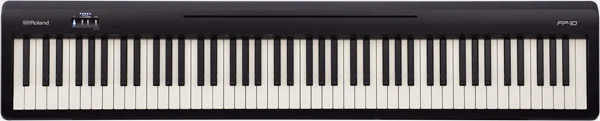
The Roland FP-10 suits a beginner who wants to learn on a full-size piano layout and an experienced player who needs a compact practice instrument. Its defining feature is the 88-key PHA-4 Standard action, rather than a long list of accompaniment rhythms. That makes it a more focused purchase than a lightweight keyboard whose main attraction is hundreds of sounds.
Roland specifies progressive hammer action, escapement and Ivory Feel key surfaces. These are meaningful design choices for practicing changes in touch and moving between registers. They do not make a digital instrument identical to an acoustic piano, and players should still check whether its resistance feels comfortable. Nevertheless, a full keyboard avoids the repeated octave changes and missing low notes that can interrupt practice on smaller instruments.
Where its simplicity helps
The FP-10 combines its piano sound engine with a modest physical interface. The published specification lists 15 tones accessible from the panel and more through the Roland Piano App. A student can concentrate on a small set of useful sounds, while app control makes deeper adjustments easier to see. The tradeoff is that someone who wants dedicated buttons for every setting may find the minimalist panel less immediate.
Twin Piano divides the keyboard into equivalent pitch ranges for a teacher and student. That is more practically useful for lessons than an impressive but rarely used sound count. Bluetooth MIDI and USB MIDI also connect the instrument to compatible learning or music software. MIDI carries performance instructions; it should not be confused with wireless headphone audio or a guarantee that every app will work without setup.
Plan the whole practice station
An 88-key instrument needs a stable stand, a seat at an appropriate height and enough room for relaxed posture. These surrounding purchases affect everyday usefulness as much as the keyboard itself. Roland supports half-pedal operation with an optional compatible pedal, so a learner advancing beyond simple sustain should include that accessory in the comparison. A basic on/off pedal and a continuous pedal do not offer identical control.
The 96-voice polyphony specification is a useful boundary rather than a musical score. Dense layers and sustained passages consume voices differently from single-note exercises. Buyers whose main purpose is elaborate layering or stage routing should compare a broader instrument's controls and connections. The FP-10's strongest case remains regular piano practice with occasional software use.
Our verdict is favorable for the player who values a full hammer-action keyboard and will leave a simple practice setup ready to use. A battery-powered keyboard is easier to carry casually, and a larger stage piano provides more direct performance control. The FP-10 makes sense when those conveniences matter less than having a focused piano within reach every day.
Sources and specifications
What works well
- Full 88-key hammer-action layout
- Twin Piano supports shared lessons
- App and USB MIDI connections
What to consider
- Large compared with portable keyboards
- Compact controls favor app or key combinations
- Budget for a suitable stand and pedal
At a glance
- Keys
- 88 PHA-4 Standard, escapement and Ivory Feel
- Polyphony
- 96 voices
- Connections
- Bluetooth MIDI and USB MIDI