Tools & DIY / Review
Bosch ROS20VSC review: a variable-speed palm sander with useful dust connections
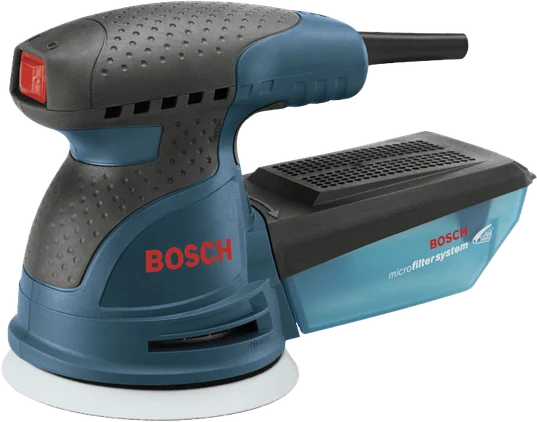
The Bosch ROS20VSC is a practical finishing sander for a workbench with reliable power and a plan for dust collection. Its 5-inch random-orbit format suits broad surfaces, while variable speed lets the user adapt the…
Review basis: This is a research-based editorial review of manufacturer documentation and published product specifications, not a hands-on test. Ratings reflect documented features and buying tradeoffs; performance claims are attributed to their sources.
The Bosch ROS20VSC is a practical finishing sander for a workbench with reliable power and a plan for dust collection. Its 5-inch random-orbit format suits broad surfaces, while variable speed lets the user adapt the tool to the material and stage of preparation. It is a better match for controlled sanding than for aggressive stock removal.
Bosch lists a 2.5-amp motor and a 7,500–12,000 OPM range. The separate speed control is useful when changing abrasive or working on a more sensitive surface. These specifications describe adjustment options; they do not guarantee a swirl-free finish regardless of grit sequence, pressure or technique.
What the design changes
The package includes a dust canister, vacuum hose adapter, sanding disc, soft pad and carrying bag. The adapter is a meaningful inclusion if the intended setup uses extraction. Check the actual hose connection before the first project rather than discovering that the vacuum and sander require another fitting after dust starts accumulating.
The pad-dampening brake and microcellular backing pad are designed to help control the finish. They complement good preparation rather than replacing it. Abrasive selection, keeping the pad appropriately supported and avoiding excessive pressure remain central to the result, particularly on thin veneers or edges.
The practical tradeoffs
The round pad’s limitation is geometric: it cannot reach a sharp inside corner. A detail tool or hand sanding will still be needed for those areas. That does not weaken its case for flat panels, shelves and tabletop preparation; it simply helps define which part of a project this tool handles efficiently.
Corded operation removes charging intervals but introduces cable routing, and a vacuum hose adds another tether. Arrange both so they do not catch on the work or pull the sander off balance. For a fixed bench this may be a small compromise, while portable outdoor work may favor a cordless model already in the user’s battery system.
Buying judgment
The ROS20VSC is a good choice when variable speed, dust-connection options and a familiar 5-inch abrasive format are the priorities. It is less compelling for someone whose main task is corner work or rapid removal of thick material. Compare the full sanding setup, including abrasives and extraction, rather than the motor rating alone.
Source
What works well
- Variable speed
- Vacuum adapter included
- Replaceable backing-pad options
What to consider
- Cord and hose can obstruct movement
- Round pad cannot finish inside corners
At a glance
- Disc
- 5 in
- Motor
- 2.5 A
- Speed
- 7,500–12,000 OPM
- Weight
- 3.5 lb