Tools & DIY / Review
Makita BO5041 review: a corded sander built around control
Variable speed and an adjustable front handle suit a workshop where battery freedom is secondary.
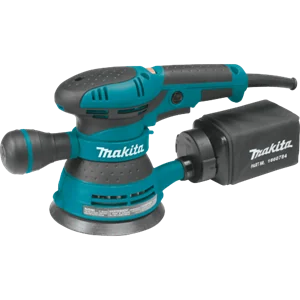
The Makita BO5041 is a useful reminder that a corded tool can still be the sensible purchase. Sanding often happens in one work area, where an outlet and dust collection are already nearby. In that setting, avoiding another battery platform can be an advantage, particularly for someone who sands intermittently but wants a dedicated tool ready for longer sessions.
Its core features
Makita specifies a three-amp motor, variable speed from 4,000 to 12,000 orbits per minute, five-inch eight-hole hook-and-loop abrasives and an adjustable front handle. A dust bag and dust nozzle appear in the current contents list. The model’s round pad is suited to broad surfaces; it does not make the tool a complete solution for every internal corner.
Variable speed gives the user a way to match the tool’s operation to the material and abrasive. It should be considered alongside the instructions for the finish you are removing or preparing. Maximum speed is not an automatic default for every surface, and a more powerful sanding approach can be counterproductive if the job calls for careful material removal.
Plan the whole sanding setup
The abrasive is a recurring part of the purchase. Check the hole pattern and size before buying a bulk pack, and make sure you have the progression needed for the project rather than several copies of one grit. A low tool price is less useful if the only locally available paper is inconvenient or poorly matched.
The dust connection also deserves attention before checkout. Confirm how your intended extraction arrangement connects and what adapters, if any, are required. The supplied bag is one option in the system, not a reason to ignore the material being sanded or the manual’s protective instructions. Keep the cord and hose route in mind when planning the workbench.
Verdict
The BO5041 offers a clear workshop proposition: variable speed, a second handle and no battery management. It is a strong format for flat-surface projects near power. Buyers whose work is mainly tight corners or frequent movement far from outlets should compare another format. Choose the sander, abrasives and extraction arrangement as one working setup.
Editorial rating: 4.1 / 5
Editorial assessment of the documented feature set, design tradeoffs, versatility and ownership requirements for the intended buyer. Features and design each contribute 30%; versatility and ownership each contribute 20%.
- Features: 4.2 / 5 (30%) — Variable speed across the documented range and a dedicated dust connection provide meaningful controls for matching a sanding setup to its material and abrasive.
- Design: 4.2 / 5 (30%) — The adjustable front handle and round-pad format make a coherent broad-surface tool, while the cord and extraction hose require a workable bench route.
- Versatility: 3.8 / 5 (20%) — The common five-inch sanding format covers varied flat-surface projects, but a round pad cannot perform every internal-corner task that a detail tool addresses.
- Ownership: 4.2 / 5 (20%) — Corded power avoids a battery platform and compatible abrasive dimensions are explicit; the full purchase still needs appropriate paper and a planned dust arrangement.
Sources
What works well
- Variable speed
- Adjustable front handle
- Corded operation avoids battery planning
What to consider
- Round pad cannot reach every internal corner
- Cord and dust setup need planning
At a glance
- Abrasive
- 5-inch, 8-hole hook-and-loop
- Speed
- 4,000–12,000 OPM
- Motor
- 3 A
- Power
- Corded