Music & Instruments / Review
Novation Launchkey Mini 37 MK4 Review: Three octaves for a portable production workflow
The Launchkey Mini 37 MK4 addresses a common frustration with portable MIDI controllers: two octaves can feel cramped just when a musical idea starts to develop. Its 37 mini keys provide another octave while preserving…
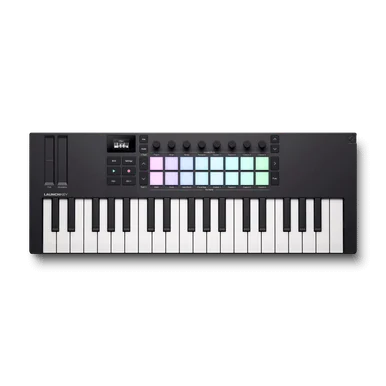
Review basis: This is a research-based editorial review of manufacturer documentation and published product specifications, not a hands-on test. Ratings reflect documented features and buying tradeoffs; performance claims are attributed to their sources.
The Launchkey Mini 37 MK4 addresses a common frustration with portable MIDI controllers: two octaves can feel cramped just when a musical idea starts to develop. Its 37 mini keys provide another octave while preserving a format intended for compact desks and travel bags. That makes it a sensible middle choice for producers who need more range but do not need a full-size keyboard action.
The distinction between this model and a full-size Launchkey 37 matters. Both the Mini designation and MK4 generation should appear in the listing you purchase. Mini keys reduce the physical span of a chord, which some players find convenient and others find unfamiliar. A pianist transferring practiced finger patterns should try the spacing before treating portability as an automatic advantage.
More range, still a production controller
Three octaves make room for wider melodies and less frequent octave shifting. They also help with chord inversions that repeatedly cross the edge of a 25-key controller. This is a real workflow benefit, but 37 keys still leave limitations for complete two-handed piano parts. The model is strongest as a writing and production surface rather than a substitute for a full digital piano.
Novation's integration and creative MIDI functions are central to the appeal. Pads and encoders let the player interact with compatible recording software, while chord, scale and arpeggiator functions can turn simple input into more developed material. These tools are most useful when the musician understands what they change. They can accelerate experimentation, but they should not conceal which notes are actually being sent to an instrument.
Application support deserves more attention than the number of illuminated controls. Check the specific recording program and version you use, including the functions available without custom mapping. A deeply integrated controller can make capture, navigation and parameter changes feel connected; a generic MIDI connection may require more preparation. The same hardware can therefore be a better buy for one studio than another.
Small controls have practical tradeoffs
The compact surface uses touch strips for pitch and modulation. They conserve space, although they offer a different physical reference from wheels. Pads also share a limited footprint with the keyboard. Producers focused on expressive finger drumming may still prefer a separate, larger pad surface, especially if percussion is the main performance rather than an occasional programming task.
As with other MIDI controllers, plan a sound source and monitoring system. Plugging it into a compatible computer is part of the process, not evidence that the controller contains a standalone synthesizer. Confirm the included software entitlements and hardware connections against the current package instead of relying on an older bundle description.
Our verdict favors the Mini 37 MK4 for mobile producers who repeatedly outgrow two octaves. Its additional range is more valuable than it first appears, particularly for melodic writing. Buyers primarily developing piano technique should spend their space budget on full-size keys; software-centered musicians have a stronger reason to choose this compact design.
Sources and specifications
What works well
- Three-octave range in a compact controller
- DAW integration and creative MIDI tools
- Pads support production workflows
What to consider
- Mini keys differ from a full-size keyboard
- Requires software or external sound source
- Deep integration varies by application
At a glance
- Keys
- 37 mini keys
- Generation
- MK4
- Controls
- Pads, encoders and pitch/modulation touch strips