Music & Instruments / Review
Arturia MiniLab 3 Review: Compact control for a software-centered music desk
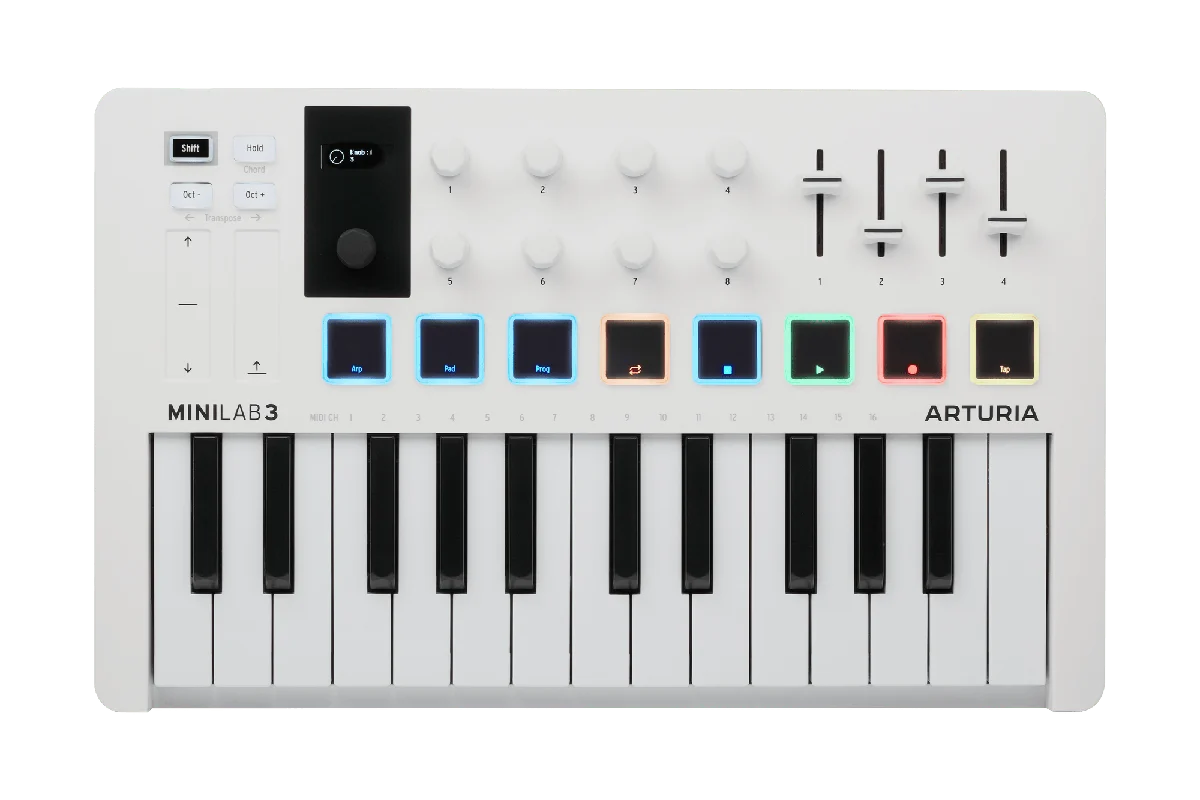
Arturia's MiniLab 3 is a practical choice for a small production desk because it provides several different kinds of control in one compact unit. Alongside 25 velocity-sensitive slim keys are eight encoders, four faders and…
Review basis: This is a research-based editorial review of manufacturer documentation and published product specifications, not a hands-on test. Ratings reflect documented features and buying tradeoffs; performance claims are attributed to their sources.
Arturia's MiniLab 3 is a practical choice for a small production desk because it provides several different kinds of control in one compact unit. Alongside 25 velocity-sensitive slim keys are eight encoders, four faders and eight pressure-sensitive pads. The combination is useful for sketching melodies, entering percussion and shaping a software instrument without reaching for the mouse at every step.
The MiniLab is a MIDI controller, so its keys send instructions to software or an external instrument. It does not replace a portable keyboard with its own speakers and sounds. A buyer starting from nothing must consider the computer or tablet, compatible software and a monitoring path as part of the setup. Existing software users are better positioned to appreciate what the hardware adds.
Controls with distinct jobs
Encoders suit parameters such as a synth filter or effect amount, while faders provide a more obvious visual reference for levels. Pads can serve percussion and performance functions. This variety makes MiniLab 3 more versatile than a similarly sized controller offering only keys and a row of knobs. The small display and browsing control also reduce reliance on memorized mappings when using supported software.
Arturia emphasizes integration with its own instruments and Analog Lab. That can make browsing and changing sounds more coherent, but buyers should also check the integration for their actual recording application. Basic MIDI communication and deep application control are different levels of compatibility. A controller can successfully play notes while still requiring custom assignments for transport or mixer functions.
Twenty-five keys are enough for bass lines, lead parts and many chord ideas. They are restrictive for two-handed arrangements, wide voicings or piano practice. Octave switching extends the available pitch range but does not create more physical space under the fingers. Musicians who regularly record two-handed parts should compare a wider controller before prioritizing the smaller footprint.
Useful beyond a laptop
USB-C provides computer connectivity and power, while the five-pin MIDI output allows connection to compatible external equipment. A pedal input adds another route for expression or sustain. This is a stronger foundation for a mixed hardware-and-software desk than a controller restricted to USB alone, although the power arrangement and destination settings still need to be planned.
The touch strips for pitch bend and modulation save space. Players accustomed to physical wheels should decide whether that control style suits their performance habits. Likewise, compact pads prioritize integration into a small surface over the generous spacing of a dedicated percussion controller. These are sensible compromises, but they remain compromises.
MiniLab 3 is most convincing as a versatile sketching and editing tool that stays beside a computer keyboard. Its selection of controls supports genuine musical tasks rather than just making the desk look busier. Buy it when compactness and software interaction dominate; move to a larger keybed when keyboard performance is the central job.
Sources and specifications
What works well
- Unusually useful mix of encoders and faders
- Traditional MIDI output alongside USB-C
- Pads and preset browsing support production
What to consider
- Two-octave range requires octave switching
- No self-contained sound engine
- Slim keys favor compactness over piano technique
At a glance
- Keys
- 25 velocity-sensitive slim keys
- Controls
- 8 encoders, 4 faders, 8 pads in two banks
- Connections
- USB-C, 5-pin MIDI output, pedal input