Automotive & Vehicles / Review
CTEK MXS 5.0 NA Review: A Focused Twelve-Volt Maintenance Tool
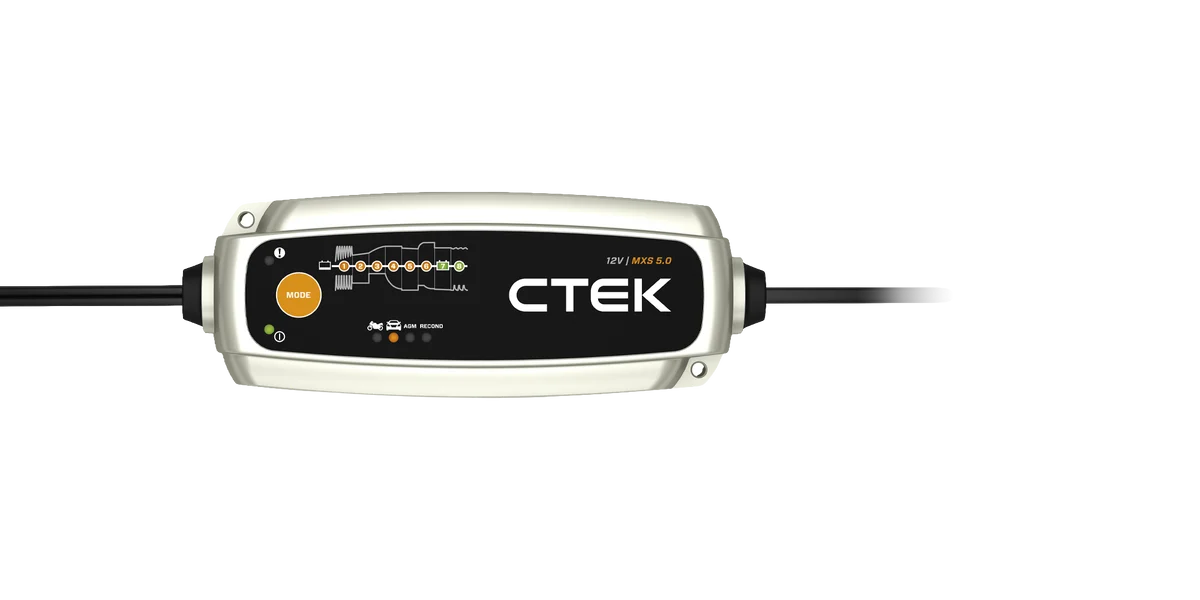
The North American version is a 4.3-amp lead-acid charger, despite the 5.0 model name.
Review basis: This is a research-based editorial review of manufacturer documentation and published product specifications, not a hands-on test. Ratings reflect documented features and buying tradeoffs; performance claims are attributed to their sources.
The buying judgment
The CTEK MXS 5.0 NA makes sense for a household concentrating on twelve-volt lead-acid batteries. Its relatively focused compatibility is easier to understand than an all-purpose charger with numerous unrelated modes. The important purchasing detail is the regional suffix. CTEK lists the North American model’s output at 4.3 amps and its input at 110–120 volts AC. Buyers should compare those specifications, rather than infer charging current or mains compatibility from the 5.0 name alone.
A defined charging role
CTEK specifies charging batteries from 1.2 to 110 amp-hours and maintenance charging up to 160 amp-hours. That makes the distinction between replenishment and storage care explicit. Someone preserving a vehicle that sits for stretches has a different requirement from someone repeatedly charging a large, heavily discharged battery on a deadline. The MXS 5.0 NA is most coherent when there is time for a normal charging session and a suitable outlet near the parked vehicle.
Compatibility before convenience
The supported list includes wet, maintenance-free, calcium, AGM, EFB and gel lead-acid types. It does not turn the product into a universal lithium charger. That boundary is useful: confirm the label on the installed battery and choose the appropriate program using the manufacturer’s instructions. The built-in temperature compensation and automatic charging cycle reduce ongoing intervention during the intended process, but neither feature replaces the initial compatibility check. Reconditioning is also a specific mode, not a general cure for every battery fault.
Living with the hardware
Alligator clamps and eyelets are included, giving the owner a choice between temporary connection and a more convenient repeated connection arrangement. The best route depends on how often the charger moves. A shared charger for several vehicles benefits from accessible storage and carefully organized leads; one assigned to a stored vehicle benefits from a connection that is easy to inspect. Consider the distance to the outlet and the battery’s location before purchase. A compact charger can still be awkward when its cabling does not suit the garage.
The verdict
The MXS 5.0 NA is appealing for owners who want a defined twelve-volt lead-acid charging routine with automatic stages and temperature compensation. It is less suitable for mixed-voltage equipment, lithium batteries or buyers seeking rapid replenishment from a higher-output charger. The five-year warranty is a useful ownership term, although it does not establish how any individual unit will behave. Choose this model because its documented battery range fits the job. The clearest reason to buy is the routine it supports, rather than the breadth of batteries it does not address.
Sources
What works well
- Focused twelve-volt lead-acid support
- Automatic temperature compensation
- Clamps and eyelets included
What to consider
- No lithium charging brief
- North American output is 4.3A
- Regional mains-input specification requires attention
At a glance
- Region
- North America
- Output current
- 4.3A
- Battery chemistry
- 12V lead-acid
- Charging capacity
- 1.2–110Ah
- Maintenance capacity
- Up to 160Ah