Automotive & Vehicles / Review
NOCO GENIUS5 Review: A Garage Charger for Several Battery Types
A five-amp charger is most useful when charging and maintenance can happen beside an outlet.
Review basis: This is a research-based editorial review of manufacturer documentation and published product specifications, not a hands-on test. Ratings reflect documented features and buying tradeoffs; performance claims are attributed to their sources.
The buying judgment
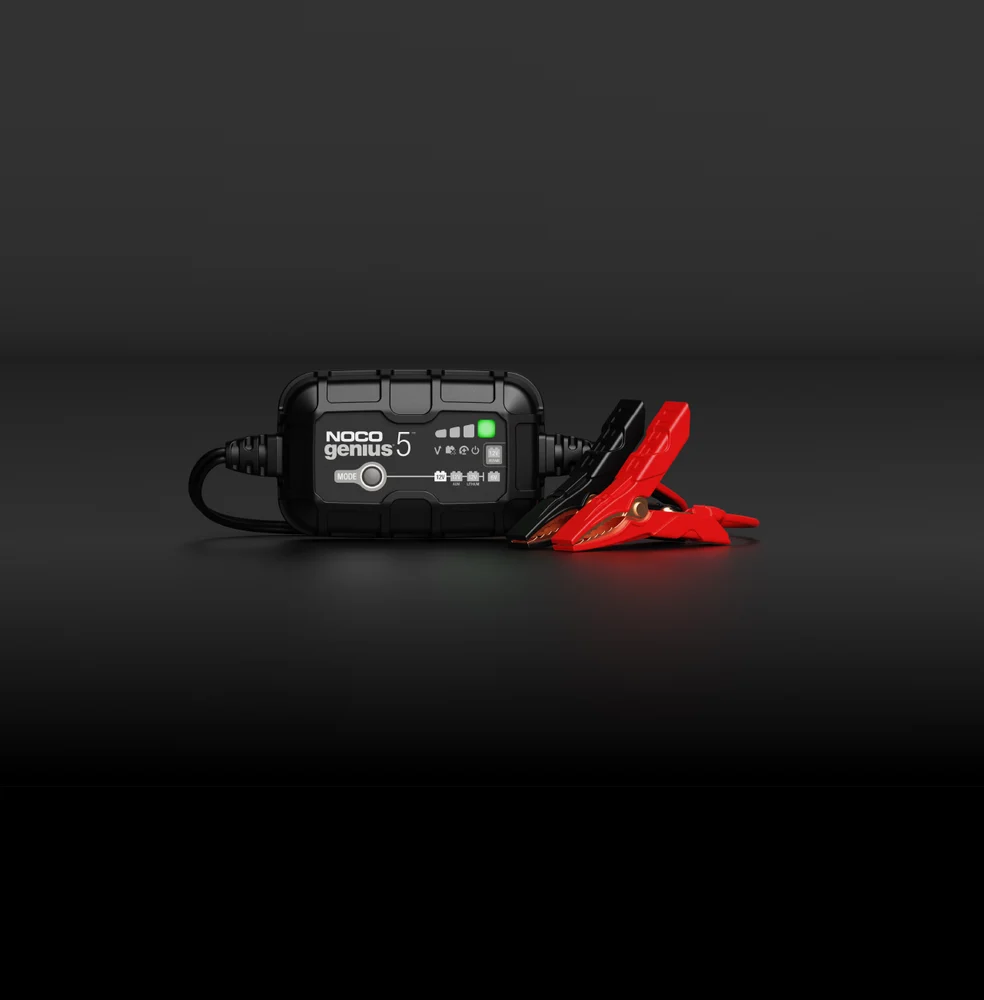
The NOCO GENIUS5 is a useful garage purchase for an owner who needs to charge and maintain more than one supported battery type. Its five-amp output places it between tiny maintainers and larger chargers intended to return substantial capacity more quickly. The six- and twelve-volt support is a meaningful distinction for households with varied equipment. It should be chosen around battery compatibility and available charging time, rather than confused with a portable jump starter that provides a brief starting assist.
Match the charger to the battery
NOCO lists supported lead-acid types and a lithium charging mode, so identifying the battery comes before selecting a mode. A car’s badge or model year is not enough information if its battery has been replaced. Read the battery label, the equipment instructions and the charger’s mode guidance together. The useful feature here is flexibility across supported batteries; the corresponding responsibility is choosing the correct setting. A single-purpose charger can be simpler for a household that has only one clearly defined battery type.
The five-amp tradeoff
A five-amp charger is a reasonable middle ground when the vehicle can remain parked for a planned session. It is not the obvious choice for someone who needs the fastest possible turnaround on a large depleted battery. NOCO specifies charging batteries up to 120 amp-hours, with maintenance support beyond that charging range. Those are different uses. Maintaining a charged battery during storage asks less of the charger than replenishing a substantial deficit, so compare competing products against the actual task.
Connections and placement
The package includes clamps with integrated eyelets and a mounting bracket. That combination accommodates occasional connections and a more organized garage arrangement. Before mounting anything, check how the mains cable and battery lead reach their destinations and how the hood or storage enclosure closes. A charger that technically reaches but leaves a cable across a walking route is not a satisfying setup. Think about where it will live between uses, and whether moving it among several vehicles would make a permanent mount inconvenient.
The verdict
GENIUS5 suits deliberate battery care more than urgent roadside recovery. Its appeal is a compact five-amp format with several supported charging modes and useful connection hardware. Owners with a single small battery may need less capability; owners regularly replenishing larger batteries may value a higher-current option. Treat low-voltage and recovery modes as specific procedures governed by the instructions, not a promise that every neglected battery can be revived. Bought for an identified battery and a realistic charging schedule, this is a flexible tool with a clear role.
Sources
What works well
- Six- and twelve-volt support
- Multiple supported battery chemistries
- Clamps, eyelets and mounting bracket included
What to consider
- Requires mains power
- Five amps prioritizes planned charging over rapid turnaround
- Correct charging-mode selection matters
At a glance
- Output current
- 5A
- Supported voltages
- 6V and 12V
- Charging capacity
- Up to 120Ah
- Input
- 120–240V AC
- Weight
- 1.5lb