Photography & Camera Gear / Review
Canon EOS R8 Review: A Light Full-Frame Body That Rewards a Deliberate Lens Choice
The original Canon EOS R8 is attractive to a photographer who wants full-frame capture without building a large camera kit. Its 24.2-megapixel sensor and uncropped 4K recording offer a substantial foundation, but the ownership decision…
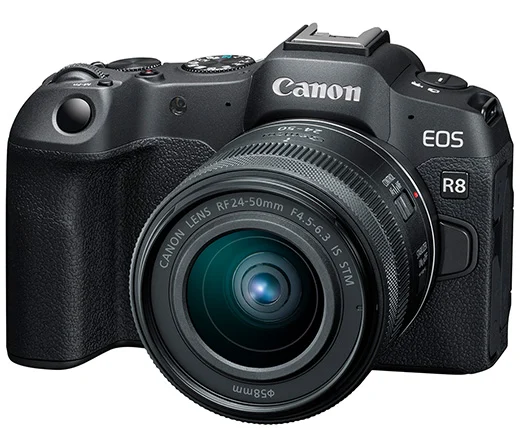
Review basis: This is a research-based editorial review of manufacturer documentation and published product specifications, not a hands-on test. Ratings reflect documented features and buying tradeoffs; performance claims are attributed to their sources.
The original Canon EOS R8 is attractive to a photographer who wants full-frame capture without building a large camera kit. Its 24.2-megapixel sensor and uncropped 4K recording offer a substantial foundation, but the ownership decision should start with the lens, battery plan and intended recording sessions. This review covers the EOS R8, not a later model carrying an additional generation suffix.
Where the design makes sense
The R8 uses Canon's RF mount. Native RF lenses keep the system straightforward, while an appropriate EF-EOS R adapter allows compatible EF lenses to remain useful. An existing lens collection can therefore change the calculation considerably. Check the exact lens and adapter combination, including the field of view, rather than assuming that every older Canon lens belongs to the same system.
A modest-resolution full-frame sensor is a sensible fit for portraits, family albums, travel and ordinary publication work. More pixels are not necessary for every output. However, someone who frequently crops distant wildlife should compare the actual final image dimensions after cropping, because a lightweight body does not supply extra subject reach by itself.
The R8 does not provide sensor-shift in-body stabilization. A stabilized lens, support or a suitable shutter speed may matter more here than on a body with IBIS. Canon's movie stabilization options have their own framing implications, so evaluate the complete video setup. Stabilization and autofocus solve different problems; neither substitutes for managing subject movement.
Video and the practical limits
Canon specifies uncropped, 6K-oversampled 4K at up to 60 frames per second. That is particularly useful when maintaining a wide lens's framing matters. It also gives a clear reason to consider the R8 beyond still photographs. A creator who publishes both photographs and short clips can use the same lens without automatically accepting a high-frame-rate crop.
Recording duration, temperature, power and memory-card requirements still belong in the plan. Check Canon's mode-specific guidance for the session you intend to record, especially before a long interview or event. Test the entire audio and recording workflow before an irreplaceable occasion. Those preparations are more useful than treating a headline resolution as a promise of unlimited recording.
Buying verdict
The single SD slot is the clearest reason for some buyers to move up the range. It cannot make a simultaneous second-card backup. That may be acceptable for personal work, but photographers who require redundant capture should choose accordingly.
For a compact full-frame everyday kit, the R8 remains a coherent design: put the budget toward an appropriate lens, compatible media and power rather than an oversized accessory bundle. It is less persuasive when the buyer specifically needs dual-card recording or in-body stabilization. Its appeal is the combination of manageable size and capable capture, provided those two omissions fit the job.
Sources and specifications
What works well
- Uncropped 4K/60p from oversampled capture
- Compact full-frame format
- RF and adapted EF lens options
What to consider
- One memory-card slot
- No sensor-shift in-body stabilization
At a glance
- Sensor
- 24.2MP full-frame
- Mount
- Canon RF
- Video
- Uncropped 6K-oversampled 4K up to 60p
- Card slot
- One UHS-II SD